
Motivation is one of the most misunderstood concepts in personal development. It’s praised as the key to success, treated like fuel for ambition, and marketed as something you can “find” if you just watch the right video or read the right quote. Entire industries are built around motivation—speeches, books, podcasts, and social media content all promise to ignite it.
And yet, despite all this motivation, most people still struggle to achieve their goals.
They start strong, feel inspired, make plans, and then—weeks or even days later—fall back into old patterns. The motivation fades. The goal stalls. The cycle repeats.
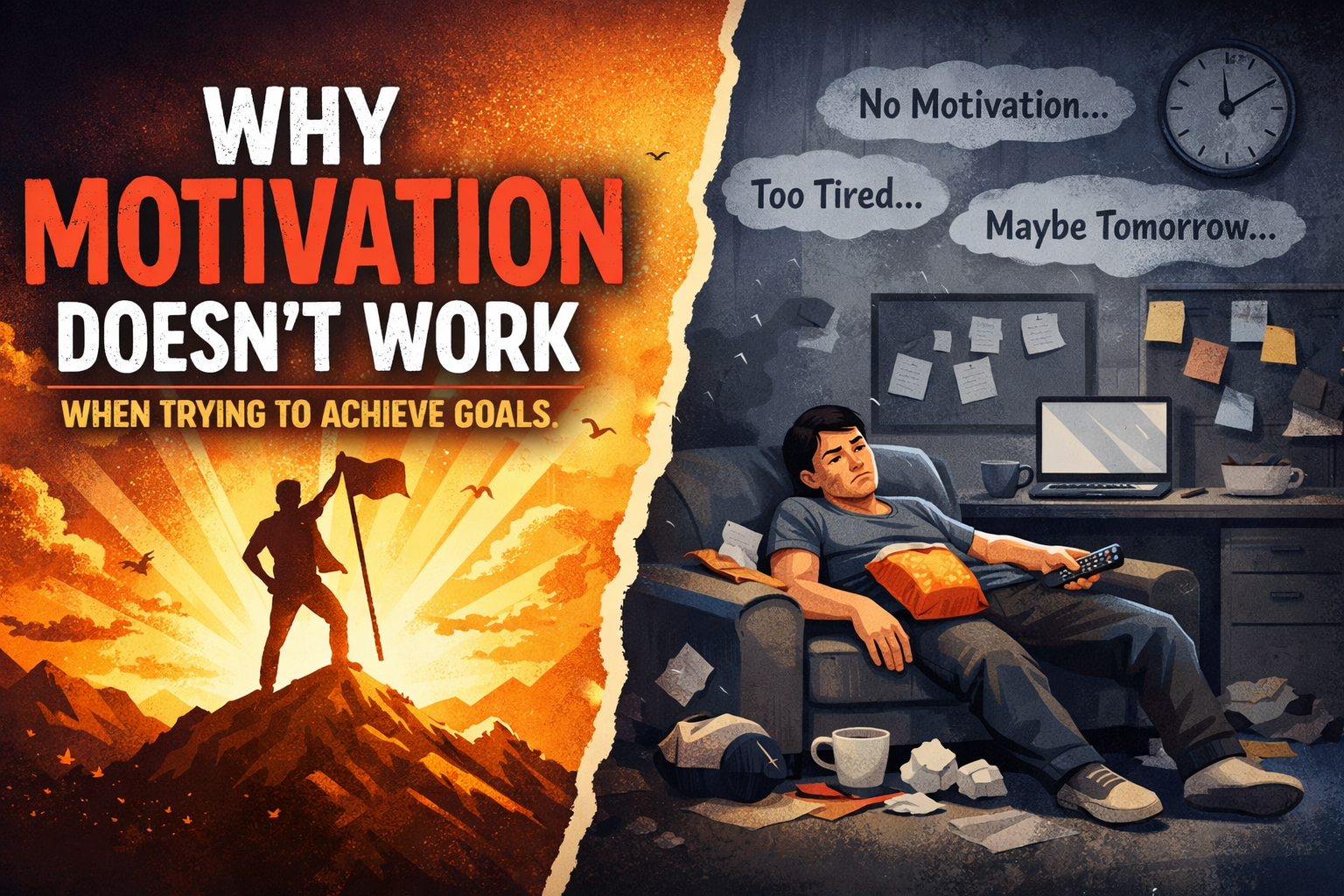
This raises an uncomfortable but important truth: motivation doesn’t work—at least not in the way most people think it does. In fact, relying on motivation is often the very thing that prevents long-term success.
This article explores why motivation fails, why it’s unreliable, and what actually works instead.
At its core, motivation is a feeling. Like excitement, happiness, or confidence, it fluctuates based on internal and external conditions. You feel motivated when:
But emotions are temporary by nature. They rise and fall depending on sleep, stress, hormones, environment, and circumstances. Expecting motivation to carry you consistently toward a goal is like expecting good weather every day—it’s unrealistic.
Goals, on the other hand, demand consistency, not emotional intensity. They require showing up when you’re tired, bored, stressed, distracted, or discouraged. Motivation doesn’t survive those moments well.
That’s the first flaw: motivation is unstable, but goals require stability.
Motivation loves new beginnings. New routines. New planners. New ideas. New identities.
The first day of a goal feels exciting because it’s different. It’s full of possibility. But real progress happens in repetition—the unglamorous middle where nothing feels new anymore.
This is where motivation collapses.
Doing the same workout for the 40th time, writing your 70th article, or sticking to a routine when results are slow offers very little emotional reward. Motivation depends on stimulation, but progress depends on repetition.
When novelty disappears, motivation follows it out the door.
One of the most damaging beliefs around motivation is the idea that you should wait for it.
People say things like:
This creates a passive relationship with your goals. Instead of acting and letting momentum build, you wait for a feeling to arrive. And the feeling rarely shows up on schedule.
High achievers don’t wait to feel motivated. They act first—and motivation sometimes follows. But when people depend on motivation as a prerequisite, they delay action indefinitely.
Ironically, action creates motivation, not the other way around.
Motivation works well in fantasy scenarios—where success is imagined without pain. But real goals come with discomfort:
Motivation isn’t built to withstand these. It’s fragile. The moment a task feels harder than expected, motivation drops.
That’s why people are motivated to start goals but not motivated to:
Discomfort exposes motivation’s weakness. Goals don’t fail because people lack motivation—they fail because motivation can’t handle resistance.
When people rely on motivation, they often fall into extreme patterns. They go all in when they feel inspired and completely disengage when they don’t.
This leads to:
Motivation promotes intensity, not sustainability. But goals require a moderate, repeatable effort over time.
Progress comes from doing a manageable amount consistently—not from rare spikes of effort fueled by emotional highs.
Life doesn’t pause so you can chase goals.
Stress, relationships, work, illness, financial pressure, and unexpected problems all compete for your energy. Motivation struggles in complex environments because it depends on ideal conditions.
If your system only works when:
Then your system doesn’t work.
Goals must survive bad days, chaotic schedules, low moods, and external pressure. Motivation alone can’t carry that weight.
Another hidden problem with motivation is that it puts responsibility on your emotional state instead of your environment.
When people fail to follow through, they often say:
This frames failure as a personal flaw instead of a design flaw.
Successful goal pursuit isn’t about willpower or motivation—it’s about structure:
Motivation is unreliable, but systems are not. If your environment makes the right behavior easier than the wrong one, you don’t need motivation to act.
Motivation is usually tied to outcomes:
This future-focused thinking creates excitement—but it also creates pressure. When progress feels slow, motivation fades because the reward feels far away.
Goals are achieved through process, not desire. Focusing too heavily on outcomes can actually reduce persistence, because it highlights the gap between where you are and where you want to be.
Process-focused systems—daily actions you can control—are far more effective than outcome-driven motivation.
Motivation often creates a false sense of progress. Feeling motivated can feel like doing something—even when nothing has changed yet.
People feel productive just by:
But identity is built through evidence, not intention. Without consistent action, motivation becomes a substitute for progress rather than a driver of it.
This can trap people in a loop where they feel inspired but remain stagnant.
If motivation doesn’t work, what does?
Create routines that run automatically, regardless of mood. Decide in advance what you do and when you do it.
Discipline isn’t about force—it’s about reducing decision-making. Fewer choices mean fewer opportunities to quit.
Tiny actions done daily outperform big actions done occasionally. Consistency beats intensity.
Make the desired behavior easy and the undesired behavior hard. Let your surroundings do the heavy lifting.
Don’t wait to feel like the kind of person who achieves goals. Act like them first, and identity will follow.
Motivation isn’t useless. It’s just overrated.
It can:
But it cannot be the foundation of your efforts. When motivation becomes the engine, progress stalls the moment emotions change.
The people who achieve goals consistently are not more motivated. They are less dependent on motivation.
Motivation feels powerful, but it’s unreliable, temporary, and fragile. It thrives in imagination and novelty, but collapses under repetition, discomfort, and real life.
Goals aren’t achieved by feeling inspired—they’re achieved by building systems that work even when inspiration is gone.
If you stop waiting to feel motivated and start designing your life around consistent action, progress becomes inevitable.
Motivation comes and goes.
Systems stay.
And goals are built by what stays.

Feel free to send us any questions you may have. We are happy to answer them.
Whether you’re training at home, teaching others, or exploring new workouts, we’re here to guide your journey.
Feel free to send us any questions you may have. We are happy to answer them.